


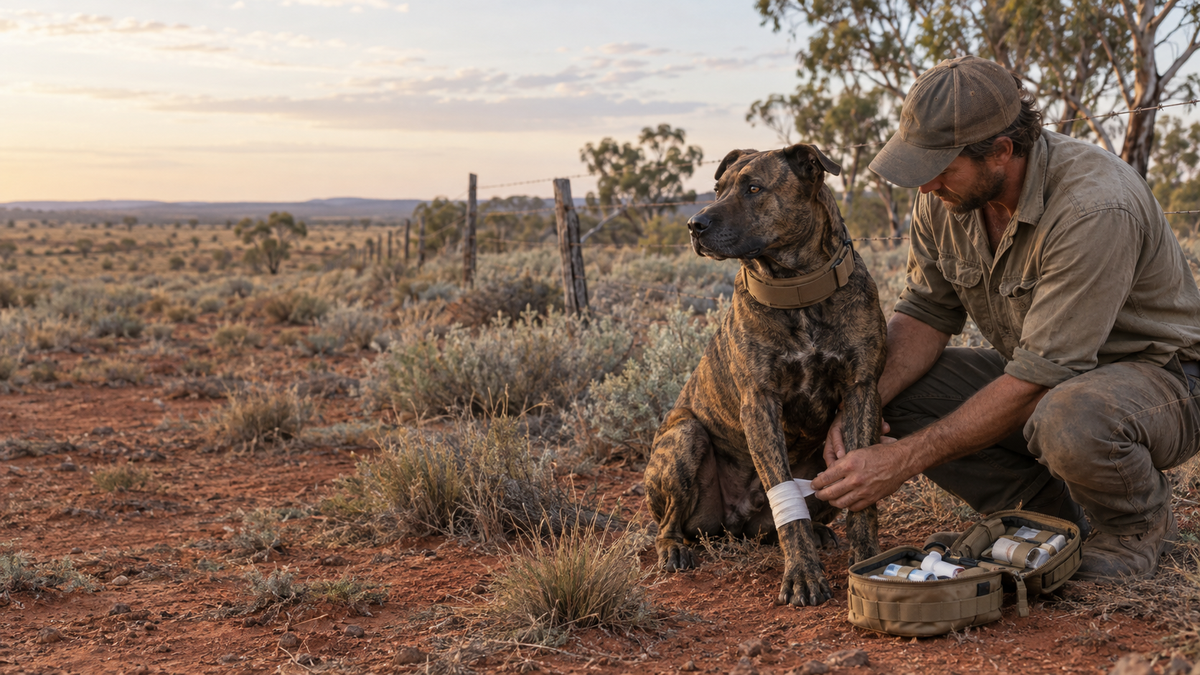
A hunting dog does its most dangerous work at the furthest point from help. The bail, the hold or the flush usually happens deep in scrub, on a back block or across a gully. That puts the dog a long walk from the vehicle and further still from the nearest vet.
Most serious hunting dog injuries in Australia come from three sources: fencing wire, the boar tusks and snakes. Each produces a different kind of emergency. Each needs a different response in the first ten minutes.
This guide is written for pig hunters, deer and game hunters, and owners of farm and field dogs. It covers what those injuries look like, what to do before you reach a vet, and how to build a kit that matches the risk you actually face.
- Wire lacerations, boar tusk wounds and snake bite account for most serious field emergencies in Australian hunting dogs. Each needs a different first response.
- Boar lacerations are one of the biggest risks a hunting dog faces. Tusk wounds are routinely deeper than they look and can hide muscle damage, contamination or chest and abdominal penetration.
- Pre-veterinary skin stapling or suturing can close a clean skin laceration for the trip out when veterinary care is hours away. It is a temporary measure, done in consultation with a vet, and never a substitute for veterinary assessment.
- Snake bite is a time-critical emergency. Brown snakes, tiger snakes and red-bellied black snakes cause the most serious envenomations in Australian dogs.
- Pressure immobilisation and keeping the dog still buy time. They do not replace antivenom, and every suspected bite needs urgent veterinary care.
- Major limb bleeding can kill a dog within minutes. A canine-suitable tourniquet such as the SWAT-T should be within reach on every hunt.
- Kit choice should follow distance from veterinary care, terrain and the type of hunting, not price alone.
- Water, energy and recovery between runs are part of first aid. A collapsible bowl and an oral energy gel prevent problems that are harder to treat later.
- The national standard operating procedure for dogs used in pest animal control expects injured dogs to receive prompt first aid and veterinary treatment.
Quick Reference: Common Hunting Dog Injuries and First Response
| Injury | Typical Cause | First Priority | Kit Required |
|---|---|---|---|
| Laceration (limb, chest, flank) | Barbed wire, ring-lock, sheet iron | Control bleeding, clean, cover | Hunting Dog First Aid Kit Compact |
| Boar tusk laceration | Boar at the bail or hold | Bleeding control, check chest and abdomen, cover | Hunting Dog First Aid Kit Standard |
| Gaping skin laceration, vet hours away | Tusk slash, wire | Clean, then pre-veterinary staple or suture closure | Staple gun and sutures in the Standard and Advanced kits |
| Major limb haemorrhage | Deep tusk or wire wound to a leg | Tourniquet above the wound, evacuate | SWAT-T Tourniquet |
| Snake bite | Brown, tiger, red-bellied black snake | Keep still, pressure immobilise, urgent vet | Hunting Dog First Aid Kit Standard |
| Multiple or severe injuries, remote | Long hunts, big country | Full trauma and stabilisation capability | Hunting Dog First Aid Kit Advanced |
| Heat stress and fatigue | Long runs, warm conditions | Shade, water, rest, energy support | Origin K9 Collapsible Dog Bowl, Vetsense Energel |
| Kit depleted after a hunt | Staples, sutures and haemostatic used | Restock before the next outing | Hunting Dog First Aid Essentials Refill |
| Uncertain assessment | Any | Structured assessment and guidance | K9 First Aid Handbook |
A hi
Why Hunting Dogs Need a Different Approach to First Aid
Patrol and detection dogs usually work close to a vehicle, a team and a plan for getting the dog out. Hunting dogs often work alone or in pairs, out of sight and well ahead of the hunter. When something goes wrong, the hunter may not reach the dog for several minutes.
That delay matters. A dog with a bleeding wound keeps moving, and a dog that has been bitten by a snake keeps working while venom spreads. By the time the hunter arrives, the injury has often had time to get worse.
Distance is the second factor. Pig hunting country in western New South Wales, central Queensland or the Northern Territory can be several hours from a vet. In Victoria's high country or Tasmania's highlands, a deer hunter may walk an hour before reaching a track.
What the National Standard Expects
The national standard operating procedure for the care and management of dogs used in pest animal control, published through PestSmart, is direct on this point. Injured dogs should receive prompt first aid, and veterinary treatment where required. Painful injuries need a vet.
For anyone using dogs in feral pig or pest control work, that standard is the baseline. Carrying the means to act on it is part of the job.
Wire Injuries: The Most Common Field Wound
Barbed wire, ring-lock and old sheet iron cause more hunting dog lacerations than anything else. A dog running flat out through a fence line can open the skin across the chest, inner thigh or flank in a single pass.
Most wire cuts look worse than they are. Some do not. The difference usually comes down to depth, location and whether a major vessel has been cut.
Assessing a Wire Laceration
Start by controlling the dog. A dog in pain will bite, including a dog that has never bitten before. Muzzle it, or have a second person hold the head, before you handle the wound.
Then look at three things. Is the bleeding steady or pulsing? How deep does the wound go? Is it over a joint, the chest or the abdomen? Pulsing bleeding, exposed muscle or a wound over the chest all point to a vet visit, not a field repair.
Managing the Wound
For a clean, shallow laceration, the priorities are simple. Stop the bleeding with direct pressure, flush the wound with saline, and cover it to keep dirt out until you can get the dog home.
The Hunting Dog First Aid Kit Compact is built for this kind of injury. It carries gauze, conforming bandage, saline, cleansing wipes, antiseptic cream, trauma shears and gloves. It also includes a disposable skin stapler and a razor for clipping hair around the wound.
Closing a wound in the field is a judgement call. Stapling or suturing should only be done in consultation with a vet, and only when getting to a clinic will take a long time. A wound closed over dirt or dead tissue will usually become infected.
Boar Lacerations: One of the Biggest Risks in the Field
Feral pigs are one of the most serious threats a hunting dog will face in Australia. A mature boar's tusks are sharp, curved and driven by a heavy, powerful animal. A boar can cause serious injuries in a few seconds.
For dogs working pigs, tusk lacerations are one of the most common reasons for an emergency vet visit. Bailing dogs are usually slashed across the shoulders, flanks and legs. Holding dogs take wounds to the chest, neck and underside when a boar swings its head.
Two Types of Tusk Wound
A slashing wound opens the skin in a long, gaping cut. It bleeds freely and looks dramatic, but the damage is often mostly in the skin and the muscle directly beneath it.
A penetrating wound is a puncture where the tusk has gone in deep. It can look small and bleed very little. That is the more dangerous wound.
The danger with tusk wounds is that the outside rarely shows what has happened underneath. A small entry wound on the chest or flank can hide torn muscle, a deep pocket of contamination, or penetration into the chest or abdomen.
Recognising a Serious Tusk Wound
Treat any wound over the chest, abdomen, neck or inner thigh as serious until a vet says otherwise. Watch for laboured or noisy breathing, air bubbling from a chest wound, a swollen or tense belly, pale gums, or a dog that suddenly goes quiet and weak.
Those signs point to internal injury or significant blood loss. They need to be stabilised and evacuated immediately, not managed in the field.
Field Management
Control external bleeding first. Cover chest wounds with a non-stick dressing and firm bandage. Keep the dog warm and still. Get moving towards a vet as soon as the dog is stable enough to carry.
The Hunting Dog First Aid Kit Standard adds the capability tusk wounds call for. That includes heavier cohesive bandages, non-adherent dressings, sutures, forceps for removing debris, and a thermometer for monitoring the dog. It is the sensible baseline for anyone running dogs on pigs.

When a Leg Wound Will Not Stop Bleeding
A tusk or wire wound that opens a major vessel in a leg can kill a dog within minutes. Direct pressure is the first step. If the wound keeps bleeding through firm pressure, a tourniquet is the next.
The SWAT-T Tourniquet is well suited to dogs. It is a wide elastic band that stretches, wraps and tucks, so it fits a canine limb better than a windlass tourniquet designed for a human arm. It also doubles as a pressure bandage, which makes it useful on wounds that need firm compression but not a full tourniquet.
Apply it above the wound, between the wound and the body, and note the time. Once a tourniquet is on, the dog needs a vet as a priority.
Pre-Veterinary Wound Closure: Skin Stapling and Suturing
When you are hours from a vet, a long, gaping tusk or wire laceration is hard to manage with a bandage alone. The dressing slips, the wound edges keep pulling apart, and dirt and debris get in during the walk out.
Pre-veterinary closure with skin staples or sutures holds the wound edges together for the journey out. It reduces bleeding and contamination and makes the dog easier to move. It is a temporary field measure, not definitive repair.
Southern K9 Systems hunting kits include a disposable 35 Wide skin stapler, a staple remover and a razor for clipping hair. The Hunting Dog First Aid Kit Standard and Advanced kits add 2/0 sutures.

When Field Closure Is Appropriate
Closure is only for the right wound in the right circumstances. Consult a vet by phone before you close a wound, and only do it when getting to a clinic will take a long time.
A wound may be suitable when all of the following are true:
- It is a skin laceration with clean, visible edges, and you can see the base of the wound.
- Bleeding has stopped or is controlled.
- The wound can be thoroughly flushed and cleaned before closure.
- The injury is recent, ideally within the last few hours.
- The dog is muzzled and safely restrained, with a second person to help.
When Not to Close a Wound
Do not close a wound in the field if any of the following apply:
- It is a puncture or penetrating tusk wound. Closing it traps bacteria inside and can lead to a serious infection or abscess.
- It is over the chest or abdomen, or you suspect it goes into either.
- It is heavily contaminated with soil, hair or plant material that you cannot fully remove.
- It is still bleeding, or there is exposed bone, tendon or joint.
- The dog is weak, pale, collapsed or showing signs of shock.
If in doubt, flush the wound, cover it with a non-stick dressing and bandage, and get moving.
Preparing the Wound
Put on gloves. Muzzle the dog and have someone hold it. A conscious dog will feel the procedure, so work quickly and calmly.
Clip the hair around the wound edges with the razor so hair does not get caught in the closure. Flush the wound thoroughly with saline from the kit, and remove visible debris with forceps. Thorough cleaning matters more than the closure itself.
Skin Stapling
Stapling is the faster of the two methods, and the easier one to do in the field.
- Use forceps or gloved fingers to bring the wound edges together. Lift them slightly so the skin edges turn outward rather than rolling inward.
- Place the stapler lightly on the skin, centred across the wound line. Do not press down hard into the wound.
- Squeeze the trigger fully to place the staple, then release and lift the stapler away.
- Work from one end of the wound to the other, placing staples roughly 5 to 10 mm apart. Use just enough to hold the edges together.
- Leave the lowest part of a long or doubtful wound open so it can drain.
- Cover the closed wound with a non-stick dressing and a light cohesive bandage.
Staples are generally removed after 10 to 14 days, once the vet is happy with healing. The kit's staple remover is designed for this.
Suturing
Suturing allows more control on irregular wound edges but takes longer and needs more skill. It should only be attempted by someone who has been trained and practised the technique.
The most practical field technique is the simple interrupted suture. Each stitch is placed and tied individually, so if one fails the rest still hold. Place each stitch a few millimetres from the wound edge and tie it just tight enough to bring the edges together without puckering the skin. Tie each knot with several throws, and cut the ends long enough to find and remove later.
After Closure
Prevent the dog from licking or chewing the closure. Monitor the wound for swelling, heat, discharge or a bad smell, which are signs of infection.
Every field-closed wound needs to be seen by a vet. The vet may decide to reopen, clean and close it properly, and will decide whether the dog needs antibiotics or pain relief. Field closure is done to get the dog to the vet in better condition.
Snake Bite: The Time-Critical Emergency
Snake bite is a serious and common emergency for working dogs in Australia. Veterinary research has estimated thousands of envenomation cases a year, mostly in dogs and cats, with most occurring in rural areas.
Brown snakes, tiger snakes and red-bellied black snakes cause the most serious envenomations in Australian dogs. Hunting and farm dogs are at higher risk because they investigate, chase and corner snakes in long grass, around dams and along creek lines.
Recognising Envenomation
Many bites are never seen. Some dogs collapse shortly after a bite, then appear to recover for a time. That apparent recovery is a dangerous trap, because the effects of the venom can come back and get worse.
Watch for sudden weakness or collapse, vomiting, trembling, dilated pupils, drooling, wobbly hind legs, or blood in urine or from the gums. Any of these after time near snake country should be treated as a suspected bite.
First Response
Keep the dog as still and calm as possible. Movement spreads venom through the lymphatic system. Carry the dog rather than letting it walk.
If the bite is on a limb, a firm pressure immobilisation bandage over the bite site and up the limb can slow venom spread. The Hunting Dog First Aid Kit Standard includes a dedicated snake bite bandage for this purpose.
Then go to a vet immediately, and phone ahead so the clinic can prepare. Do not cut the wound, apply ice or wait for symptoms to develop. The only definitive treatment is antivenom, and outcomes are significantly better when it is given early.
Water, Energy and Recovery on Long Hunts
Not every field emergency starts with a wound. Many start with a dog that has run hard for hours in warm conditions with too little water. Heat illness is one of the leading causes of death in working dogs, and hunting dogs are among the most exposed.
Prevention is simpler than treatment. Offer water at every break, rest in shade, and watch for heavy panting, a dark red tongue, stumbling or a dog that stops responding to commands.
Getting Water into the Dog
A dog will not drink properly from a cupped hand or a bottle neck. It needs a bowl it can put its face into. Without one, most dogs drink far less than they need.
The Origin K9 Collapsible Dog Bowl is designed by former Australian Special Forces personnel and made from military-spec materials. It folds flat into a pocket or a pack's side pouch and opens in seconds, so there is no reason to leave it behind. It is available in Multicam Black, Black and Coyote for $49.90.
Energy Support Between Runs
A dog that has worked a long run burns through its readily available energy quickly, particularly in heat. When another run is likely, giving it something it can absorb quickly during the break supports its readiness for the next effort.
Vetsense Energel is an oral glucose and electrolyte supplement made for working dogs. It comes in a 60 mL metered-dose syringe, so a measured dose can be given in the field without mixing or refrigeration. At $12.90 a syringe, it is worth carrying several on every hunt and keeping a few in the vehicle.
Energel supports recovery. It does not replace water, rest or veterinary care. Never give anything by mouth to a dog that is collapsed, fitting or unable to swallow, and check dosing for your dog's size with your vet.
Building the Right Kit for Your Hunting
There is no single correct kit. The right choice depends on how far you are from a vet, what you are hunting, and how many dogs you run.
Day Hunts Close to Help
For short hunts on familiar country within an hour of a clinic, the Hunting Dog First Aid Kit Compact covers minor to moderate wounds, ticks and eye irritation. It is light enough to carry on every outing, which matters more than any kit left in the ute.
Pig Dogs and Remote Country
For anyone running dogs on pigs, or hunting more than an hour from a vet, the Standard kit is the appropriate baseline. It adds snake bite capability, heavier wound management and the means to close a wound in consultation with a vet when getting to a clinic will take time.
Long Hunts and Multiple Dogs
The Hunting Dog First Aid Kit Advanced is designed for big country, multi-day trips and teams of dogs. It includes everything in the Standard kit, plus a SWAT-T tourniquet for major limb bleeding and Vetsense Energel to support dogs through sustained exertion.
Restocking After Every Hunt
A kit is only ready if its contents are. Staples, sutures and haemostatic dressings are the items most often used on a hunt, and the items most often not replaced.
The Hunting Dog First Aid Essentials Refill replaces those items in one pack. It contains a skin staple gun kit, SureKlot haemostatic dressing for bleeding that will not settle with pressure alone, sutures, and Vetsense Energel. Restock as soon as you get home, while you still remember what was used.
Knowing What to Do
Equipment is only half the picture. The K9 First Aid Handbook is a waterproof field reference covering assessment, muzzling, normal vital signs, haemorrhage control, lacerations, fractures, heat illness, poisoning and envenomation. It is built to be read in the field with dirty hands.
Common Operational Challenges
The Kit Stays in the Vehicle
The most common failure is simple. The kit is in the ute, and the dog is a kilometre away in a gully. A compact kit carried on the hunter is worth more than a comprehensive one left behind.
No Muzzle, No Treatment
A hurt dog will bite. Hunters who skip muzzling often end up injured themselves, which leaves nobody able to treat the dog. Practise muzzling at home, when the dog is calm.
Underestimating Tusk Wounds
Small puncture wounds are easy to dismiss at the end of a long night. Tusk wounds carry a high infection risk and can hide deep damage. Any tusk wound should be checked by a vet.
Waiting on Snake Bite
Dogs that collapse and then seem to recover are often taken home to "see how they go". That delay can be fatal. A suspected snake bite always means an immediate trip to the vet.
Ticks and Heat
In eastern Australia, paralysis ticks put an estimated 10,000 dogs and cats in front of vets each year. Heat illness is a leading cause of death in working dogs. Both need routine checks after every hunt, especially in spring and summer.
No Water Plan
Many hunters carry water for themselves but have no practical way to get it into the dog. Carry a bowl and enough water for every dog, and plan breaks around dams and creek crossings.
An Empty Kit
Used staples and sutures that never get replaced leave the kit looking complete when it is not. Check it after every hunt and restock straight away.
How Southern K9 Systems Supports Hunting Dog Teams
Southern K9 Systems supplies purpose-built first aid kits for hunting, farm and conservation dogs across Australia. The range is designed around the injuries those dogs actually suffer, and informed by veterinary science.
- Hunting Dog First Aid Kit Compact — lightweight kit for minor to moderate wounds, $139.90
- Hunting Dog First Aid Kit Standard — adds snake bite, sutures and heavier wound management, $249.90
- Hunting Dog First Aid Kit Advanced — full capability including SWAT-T tourniquet and Energel, $349.90
- SWAT-T Tourniquet — canine-suitable tourniquet and pressure bandage, $39.90
- Hunting Dog First Aid Essentials Refill — staple gun kit, SureKlot, sutures and Energel to restock after a hunt
- Vetsense Energel — oral glucose and electrolyte supplement in a 60 mL metered-dose syringe, $12.90
- Origin K9 Collapsible Dog Bowl — packable field water bowl, $49.90
- K9 First Aid Handbook — waterproof field reference, $22.48
Free domestic shipping applies to orders over $300.
Final Thoughts
Hunting dogs work hard, take risks and often get hurt where help is hardest to reach. That is the nature of the work, and most hunters accept it.
What changes the outcome is the first ten minutes. A dog with bleeding controlled, a wound covered or a bite bandaged arrives at the vet in a much better position than one that was not treated.
The equipment to do that is small, light and inexpensive compared with the cost of losing a good dog. Carrying it, and knowing how to use it, is the responsibility of the person who takes the dog out.
FAQs
What is the most common serious injury in Australian hunting dogs?
For dogs working pigs, boar tusk lacerations are one of the biggest risks and among the most common reasons for an emergency vet visit. Wire and fencing cuts are frequent across all hunting dogs. Snake bite is the most time-critical emergency a hunting dog will face.
Can I staple or stitch my dog's wound in the field?
Yes, as a pre-veterinary measure when a vet is hours away and the wound is suitable. The Compact, Standard and Advanced kits include a skin stapler, and the Standard and Advanced kits add sutures. Only close clean skin lacerations, after consulting a vet by phone. Never close puncture wounds, contaminated wounds, or wounds over the chest or abdomen. Every closed wound must then be seen by a vet.
Is a human tourniquet suitable for a dog?
Many windlass tourniquets designed for human limbs do not fit a dog's leg well. The SWAT-T is a wide elastic band that conforms to the shape of a canine limb and can also be used as a pressure bandage. It is the tourniquet included in the Advanced kit.
How do I apply a pressure immobilisation bandage to a dog?
Apply a firm elastic bandage over the bite site, then wrap up the limb as far as possible. It should be firm but not tight enough to stop circulation. Keep the dog still and carry it to the vehicle. The K9 First Aid Handbook includes step-by-step guidance.
My dog was bitten by a snake but seems fine now. Do I still need a vet?
Yes. Dogs often collapse and then seem to recover for a time after a bite. The effects of the venom can come back and get worse. Every suspected snake bite needs immediate veterinary assessment.
Which kit should a pig hunter carry?
The Standard kit is the recommended baseline for pig hunting. It covers tusk wounds, snake bite and heavier bleeding. Hunters working remote country or running several dogs should consider the Advanced kit, which adds a SWAT-T tourniquet and Energel. Whichever kit you carry, add an Origin K9 Collapsible Dog Bowl and keep an Essentials Refill on hand to restock after each hunt.
Do I need first aid training to use these kits?
Most of the contents can be used by a hunter with basic knowledge. Wound closure and tourniquet use benefit from training. The K9 First Aid Handbook gives a structured reference, and a practical canine first aid course is strongly recommended for anyone who hunts regularly.
Specialist Working Dog Equipment
Origin K9, EARTSCH and K9 first aid capability — available now with free domestic shipping on orders over $300.
Shop Southern K9 Systems
Share:
Working Dog Welfare on Extended Shifts