


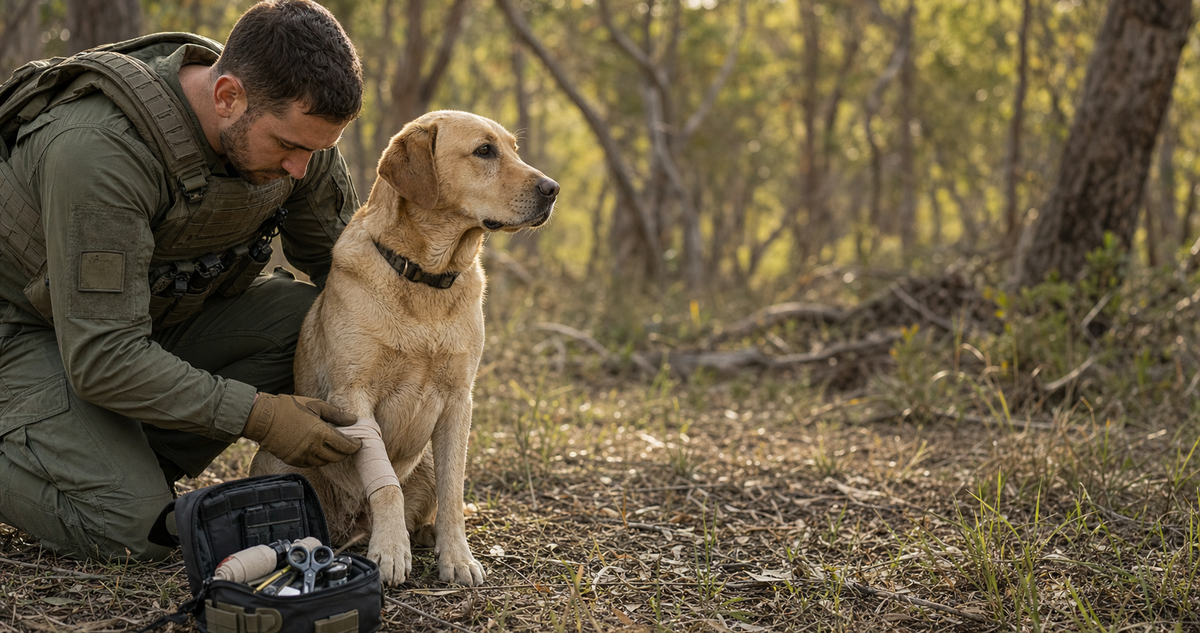
- A standard human first aid kit is not appropriate for dog-specific emergencies. Canine anatomy, fur, and the nature of working dog injuries require purpose-built supplies.
- The level of kit you need depends on the environment your dog operates in — backyard, bushland, active patrol, or combat-adjacent work.
- Bleeding, snake bite, overheating, and soft-tissue trauma are the four most common field emergencies for working and hunting dogs in Australia.
- Southern K9 Systems offers purpose-built K9 first aid kits across four capability tiers — from everyday domestic use through to austere-environment tactical deployments.
- The right kit is pre-staged, contents-known, and practised with. Gear you have never opened does not help in an emergency.
| Kit | Best For | Price | Link |
|---|---|---|---|
| Low Risk DFAK | Everyday domestic and low-risk environments | $99.90 | View |
| Compact K9 IFAK | High-risk environments, patrol, working dogs | $199.90 | View |
| Large K9 IFAK | Extended operations, general working dog use | From $299.96 | View |
| Advanced K9 IFAK | Military and law enforcement working dogs | $359.90 | View |
| Hunting Dog Kit — Compact | Hunting dogs, field use, bushland environments | $139.90 | View |
| Hunting Dog Kit — Advanced | Extended field operations, remote hunting trips | $349.90 | View |
Why Your Dog Needs Its Own Kit
Most dog owners already know they should have a first aid kit for their dog. Fewer of them have one. And of those who do, most are carrying something assembled from leftover human supplies — a bandage here, some antiseptic there — that was never designed for canine use.
That is not necessarily negligence. It is usually a gap in information.
A dog's physiology, coat, and the nature of the injuries they commonly sustain in the field all point toward purpose-built supplies. Wound dressings that do not adhere to fur. Cohesive bandages that can be applied over a coat without losing integrity. Haemostatic gauze that works on lacerations from wire, barbed undergrowth, or weapon contact. A canine muzzle, because a dog in pain bites — including its handler.
These are not exotic supplies. They are practical items that belong in a kit built for the animal you are responsible for.
The Four Most Common Field Emergencies for Dogs in Australia
1. Lacerations and Penetrating Injuries
Wire fencing, rough undergrowth, glass, and in tactical environments, ballistic or edged-weapon contact. Deep lacerations are the most common serious injury in hunting and working dogs. The priority is haemorrhage control — the same principle that applies in human trauma. Clean the wound, apply pressure, pack if necessary, and get the dog to veterinary care as quickly as possible.
The Advanced K9 IFAK includes both a SWAT-T Tourniquet and haemostatic gauze (RapidStop and BleedSolv) — two different tools for two different stages of haemorrhage control. For limb injuries with arterial involvement, a tourniquet applied proximally buys time. For truncal or non-tourniquetable wounds, haemostatic packing is the appropriate intervention.
2. Snake Bite
Australia has the highest concentration of venomous snakes in the world. Working and hunting dogs encounter them in exactly the environments they operate in — dense scrub, long grass, log piles, rocky outcrops.
A bitten dog will often present with sudden collapse, vomiting, weakness, and respiratory distress. The primary field intervention is immobilisation and the application of a compression bandage to slow lymphatic spread of venom. Every kit in the Southern K9 Systems range includes a snake bite bandage. The Advanced K9 IFAK also includes an aluminium splint, which assists in immobilising a limb to reduce venom spread.
The most important thing you can do after applying a pressure immobilisation bandage is move the dog immediately to veterinary care. There is no antidote you can administer in the field.
3. Overheating and Hyperthermia
Working dogs — particularly brachycephalic breeds and thick-coated breeds — are at significant risk of heat-related illness during summer operations. An Origin K9 Collapsible Dog Bowl is one of those pieces of gear that earns its place on every patrol, every field day, and every summer walk. Consistent access to water is not a luxury in the Australian climate. It is a welfare requirement.
The Advanced K9 IFAK includes a thermal emergency blanket, which — counterintuitively — has application in both hypothermia and hyperthermia management. Wet the blanket and drape over the dog to assist cooling during a hyperthermic episode.
4. Soft Tissue and Eye Injuries
Thorns, grass seeds, dust, and debris are constant hazards in field environments. The Advanced K9 IFAK includes five units of eyewash and cleansing wipes for management of ocular and surface contamination. Grass seeds in particular — common across Tasmania, Victoria, and inland Australia — can penetrate the ear canal and eye, causing significant damage if not flushed promptly.
Choosing the Right Kit for Your Dog's Role
Everyday Domestic Use
If your dog is primarily a pet with occasional bush walks or beach access, the Low Risk Dog First Aid Kit at $99.90 covers the common bases — wound management, eye wash, bandaging, and basic trauma response. It is compact, practical, and designed for the kinds of injuries that happen in backyards, on footpaths, and at the local park.
The most important thing about any first aid kit is that you know what is in it. Open it. Read the contents. Know where the items are before you need them.
Hunting Dogs and Field Work
Australia's hunting and pig-dogging community operates their dogs in some of the most demanding environments a working dog can be asked to perform in. Barbed wire, aggressive quarry, remote terrain, and heat are constants.
The Hunting Dog First Aid Kit range is designed specifically for this context — from the Compact kit at $139.90 through to the Advanced at $349.90. The Advanced kit includes haemostatic gauze and a SWAT-T Tourniquet alongside the standard wound management, bandaging, and snake bite supplies. For trips involving multi-day remote access, the Advanced kit is the appropriate baseline.
Working Dogs in High-Risk Environments
For police dogs, security dogs, customs and biosecurity dogs, and dogs operating alongside tactical teams, the Compact K9 IFAK at $199.90 or Large K9 IFAK from $299.96 are the appropriate starting points. These kits are housed in dedicated IFAK pouches designed to be attached to a handler's kit — within reach, not buried in a bag.
The staging of the kit matters as much as the contents. A first aid kit that is in the boot of the vehicle is not immediately accessible when the dog is injured in a building 200 metres away.
Military Working Dogs and Austere Environments
The Advanced K9 IFAK at $359.90 is the top-tier option — built to K9 TECC (Tactical Emergency Casualty Care for Canines) guidelines and informed by active tactical canine handlers and veterinary input. It includes a decompression needle for tension pneumothorax, HyFin chest seals, a surgical razor, and a thermometer alongside the full haemorrhage control and wound management loadout.
It is housed in the MyMedEquip Vertex Pro Aide Pouch (25×10.5×18cm) — a pouch that is MOLLE-compatible and designed for austere-environment carry. Stock is limited — as of publication, only two units remain.
What Good Preparation Actually Looks Like
Having the right kit is half the equation. The other half is knowing how to use it.
The K9 First Aid Handbook is a $22.48 field-readable guide designed to accompany the Southern K9 Systems kit range. It covers the interventions relevant to each kit tier — from wound management to haemorrhage control to snake bite response.
The K9 TECC Reference Cards at $12.90 are laminated decision-support cards based on the K9 TECC framework. They are designed to be kept inside the kit and consulted under stress — because stress affects recall, even for trained handlers.
The K9 Casualty Card at $1.20 is included in most kit tiers. It allows you to document the dog's vital signs, interventions applied, and timeline of events — information that is directly relevant to the veterinarian who takes over care.
Gear Is Part of Preparedness — Not the Whole of It
A first aid kit does not replace veterinary care. It extends the window between injury and that care. The best kit you own is the one that buys time effectively, is in a location you can access quickly, and contains supplies you have practised with.
That readiness mindset is not exclusive to tactical handlers. It belongs to anyone responsible for a dog in an environment where injuries can happen — and in Australia, that includes backyard dogs in snake country, beach dogs in summer heat, and farm dogs in wire-fence paddocks.
Your dog cannot tell you it is hurting. The least you can do is be ready.
FAQs
Can I use a human tourniquet on a dog?
The SWAT-T Tourniquet included in Southern K9 Systems kits is specifically selected because its wrap-and-tuck application method can be adapted to canine limbs, which vary significantly in diameter from human limbs. Standard windlass tourniquets designed for human limbs are generally not appropriate for canine application.
What is K9 TECC?
K9 Tactical Emergency Casualty Care (K9 TECC) is a framework adapted from the human TCCC (Tactical Combat Casualty Care) guidelines for application to canine patients in tactical and high-risk environments. It provides a structured approach to haemorrhage control, airway management, and shock management in working dogs.
Are the kits useful for domestic dogs or only working dogs?
The kits are designed with working dog environments in mind, but the injuries they address — lacerations, snake bite, soft-tissue trauma — are not exclusive to working dogs. Any dog that spends time outdoors in Australia benefits from a purpose-built first aid kit.
What is the difference between the Compact and Advanced K9 IFAK?
The Compact K9 IFAK addresses the most common field emergencies — bleeding control, basic wound management, eye care, muzzle, and thermometer. The Advanced K9 IFAK adds haemostatic gauze, chest seals, a decompression needle, a splint, emergency blanket, and snake bite bandage — making it appropriate for austere environments where evacuation may be delayed.
Should I carry a handler IFAK alongside a K9 IFAK?
Yes. The Handler IFAK is a separate bleed control kit designed for the handler — ensuring that both handler and dog can receive initial care from a single operator if required. The two kits are designed to complement, not duplicate each other.
How do I know which kit size my dog needs?
Start with the environment. Domestic or low-risk environments: Low Risk DFAK. Field, hunting, or occasional high-risk use: Compact or Hunting Dog kit. Active patrol or working deployment: Large K9 IFAK. Austere, prolonged, or combat-adjacent environments: Advanced K9 IFAK.
Shop K9 First Aid & Medical
Choose the right kit for your dog's role. Purpose-built for Australian conditions — from backyard basics to austere-environment tactical deployments. Free domestic shipping on orders over $300.
Shop Southern K9 Systems
Share:
Working Dog Welfare on Extended Shifts