


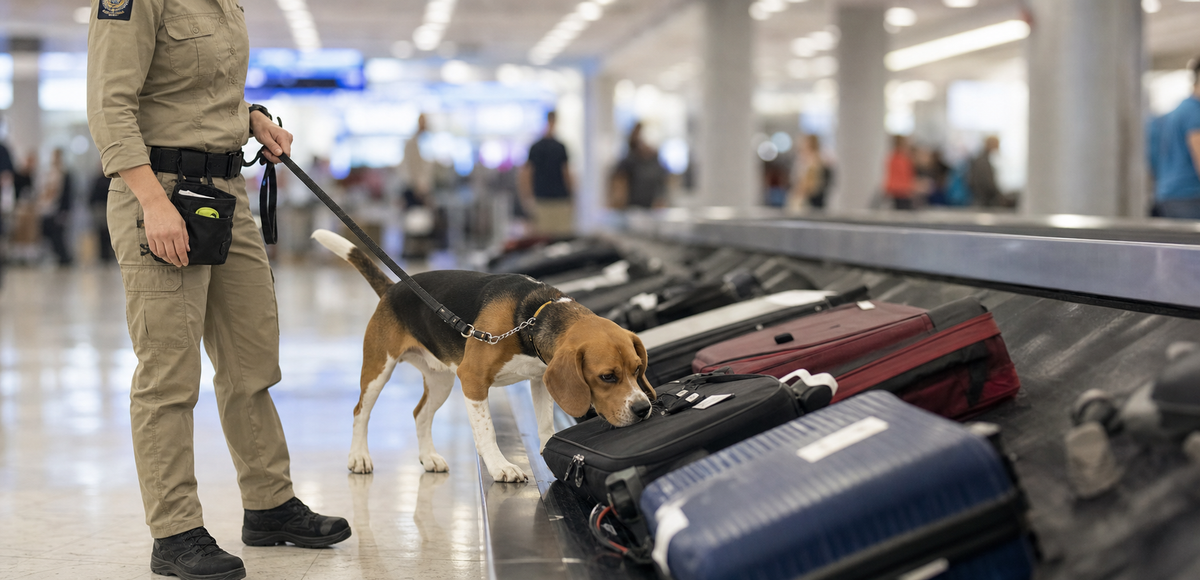
Australia's biosecurity detection dogs work where the flow never stops. International arrivals, cargo movements and mail volumes create a high-throughput environment where teams must identify risk without disrupting legitimate movement.
That task is operational, not ceremonial. The dog provides a fast mobile detection capability; the handler manages search pattern, public interaction, risk assessment, welfare and the decision-making that follows an indication.
The scale explains why equipment discipline matters. DAFF reported 56 operational detector dogs in 2025, trained across nine target odour groups covering more than 200 biosecurity-risk commodities. A handler's gear does not replace training or local operating procedures. It supports them.
- Biosecurity detector dog teams need a compact, repeatable loadout that supports detection work, welfare and rapid transitions between tasks.
- Reward delivery must be immediate and consistent, which makes pouch placement and access part of the detection system.
- Hydration is a readiness issue during extended shifts, particularly around hard flooring, heat, vehicle movements and high foot traffic.
- Handler-carried first aid should be planned for the dog, handler and immediate worksite, then aligned with site medical arrangements.
- Leads and transition collars should be selected for the team's approved handling methods, not for appearance or general-purpose convenience.
- Pre-deployment checks should include equipment condition, dog presentation, water, reinforcement, communications and the day's operating environment.
- Sustainment matters as much as issue. Teams need cleaning, inspection, replacement and succession planning built into normal operations.
Quick Reference: Detection Roles and Gear Requirements
| Operational Role or Condition | Primary Requirement | Field-Ready Gear Approach | Why It Matters |
|---|---|---|---|
| Passenger and baggage screening | Fast reinforcement and controlled movement | Accessible reward pouch, approved lead and water source | Maintains motivation while enabling clean transitions around the public |
| Mail and cargo screening | Repeatable search pattern over changing work areas | Low-profile lead system, water bowl and first-aid carriage | Supports sustained work around equipment, pallets and vehicle activity |
| High-throughput surge periods | Readiness across multiple short work cycles | Pre-staged rewards, hydration and backup consumables | Reduces avoidable delays between deployments |
| Austere or remote inspection areas | Self-sufficiency and welfare control | Collapsible bowl, water plan, K9 first-aid kit and durable lead | Limits dependence on facilities that may be unavailable or distant |
| Training and transition work | Clear handling cues and reinforcement timing | Training-approved collar, lead and reward pouch | Helps preserve consistent mechanics between training and deployment |
| Heat, weather or lengthy shifts | Welfare monitoring and recovery | Water access, shade or cooling plan, rest-cycle coordination | Protects performance, safety and long-term sustainment |
The Operational Context for Biosecurity Detection Dogs in Australia
Detection Capability Sits Inside a Wider Border System
Biosecurity detection dogs work alongside DAFF officers, Australian Border Force partners, screening technology and inspection processes. The dog locates target odours in conditions that change by the hour. The handler guides the search, reads behaviour and assesses risk after a response.
DAFF describes handlers as trained biosecurity professionals who screen travellers, cargo and mail, while managing daily training, welfare and their own handling competence. Regular maintenance training and verification are core to readiness.
This is why equipment must integrate with the task. A pouch that delays reward, a lead that tangles in a screening lane or a missing water option creates friction precisely where teams need reliable tempo.
The Threat Is Measured in Individual Intercepts
In 2025, biosecurity detector dog teams intercepted more than 45,500 risk items arriving through international airports and mail gateway facilities. Detector Dog Ghost, working in Adelaide with handlers Rebecca and Jade, intercepted 3,202 items during that year and was named DAFF's Top Dog for 2025.
Each item in a kit list must earn its place by reducing friction, managing risk or protecting the dog's ability to work accurately.
Build the Core Handler Loadout Around the Work Cycle
1. Reinforcement: Keep the Reward Immediate and Protected
Detection dogs learn to associate a target odour with a reward. DAFF notes that rewards may include food, a game or a pat, depending on the team and training system. The central principle is clear: motivation must remain strong through the dog's career.
For a handler, the operational requirement is simple. Reinforcement must be available at the correct moment without a search through pockets, a dropped item or an unnecessary change of body position.
A dedicated Operator Reward Pouch gives teams a defined location for detection reinforcement. Place it where the handler can access it with the least movement, while keeping the dog's working line and the surrounding public clear.
Use a pre-shift check:
- Confirm the selected reward is permitted for the shift and suitable for the dog's current work plan.
- Check quantity, freshness and containment before entering the operational area.
- Rehearse access with gloves or outer garments if these are part of the day's task.
- Confirm where replenishment will occur and inspect closures after high-volume work.
Consistent reward timing protects the dog's search behaviour and helps the handler maintain a calm, predictable routine.
2. Hydration: Establish Water Access Before the Team Deploys
A dog may work in climate-controlled terminals, exposed cargo areas, vehicles and temporary screening points in the same shift. Ambient temperature is only one factor; hard surfaces, noise, transport, task intensity and waiting periods also affect welfare and recovery.
The water plan should identify a safe water source, who carries it, a suitable drinking point and how intake will be monitored. If it depends on finding a facility later, it is not reliable.
A compact Origin K9 Collapsible Dog Bowl is a practical welfare item for extended shifts, vehicle movements and tasking away from established facilities. Pair it with a clean water source and site-specific cleaning routine.
Handlers should use planned water opportunities, not wait for obvious fatigue. A dog that is uncomfortable, overheated or under-recovered cannot deliver dependable detection capability.
3. Control and Transition Equipment: Use Only Approved Handling Systems
A lead and collar are not generic accessories in a detection environment. They influence how the dog enters a search area, receives direction, moves around passengers or equipment, and transitions back to transport or rest.
The operational baseline is consistency. Use equipment that suits approved handling techniques, the dog's training stage and local safety assessment. Do not introduce unfamiliar equipment during a demanding shift.
For approved transition or training applications, an Origin K9 Slip Collar can provide a simple dedicated option. Origin K9 Leads give handlers a purpose-built option for controlled movement and routine K9 work. Select lead length and configuration against the actual operating space.
Before each deployment, inspect the lead, collar, hardware and attachment point. Remove damaged equipment from service.
4. First Aid: Carry Immediate Capability, Then Link to the Site Response Plan
Detection dog teams frequently work close to people, machinery, sharp packaging, vehicles and hard surfaces. Most shifts will end without an incident. That is not a reason to carry no immediate response capability.
A handler-carried kit should address the first minutes of a foreseeable injury while the team activates site medical support, veterinary advice or emergency services.
The Defender First Aid Kit and Tactical D-FAK Compact provide two compact options for teams developing a handler-carried first-aid solution.
Build the first-aid decision around risk, not product size:
- Identify the most credible injuries for the site, dog, handler and shift pattern.
- Confirm staff competence, applicable protocols and escalation contacts.
- Separate K9-specific requirements from human first-aid requirements where procedures demand it.
- Log inspections and replace used or expired contents immediately.
Pre-Deployment: Make Readiness Routine
Use a Short Readiness Checklist
A checklist creates a common standard across early shifts, surge periods and tasking changes.
- Mission: Confirm search objective, target area, expected pace and supervisor contact.
- Dog: Check presentation, behaviour, hydration, elimination, rest status and any welfare concerns.
- Control: Inspect collar, lead, attachment hardware and any approved backup system.
- Reinforcement: Check reward type, quantity, pouch access and replenishment plan.
- Water: Carry water and bowl, then identify the next safe water point.
- Medical: Confirm handler-carried first aid, site medical arrangements and emergency communication.
- Environment: Note heat, noise, crowds, vehicle activity, slippery surfaces and restricted routes.
- Documentation: Carry or access the operational records required by local policy.
Pack for Sustainment, Not Just the First Hour
Busy border environments create repeated starts and stops. Stage practical replacements close enough to maintain readiness when items are consumed, contaminated or damaged. A sustainment cache may include reserve rewards, clean water, cleaning supplies, approved spare control equipment, replacement first-aid consumables and an inspection log.
Welfare Is an Operational Requirement
Work Intensity Must Be Balanced With Recovery
A team can be rostered for an eight- to ten-hour shift, but the dog should not be treated as if it is searching continuously for that entire period. Working blocks, rest, water, transport and enrichment must be planned around the real search task and local procedures.
The handler is best placed to identify subtle changes in enthusiasm, gait, recovery, focus or behaviour. Report them early. Maintaining a dog's welfare is not separate from detection performance; it is part of the same responsibility.
Keep Hygiene and Equipment Care Proportionate to the Work
Biosecurity operations add a further consideration: equipment can move through public, cargo and controlled work areas. Build cleaning and storage into the plan so that bowls, pouches, leads and first-aid cases remain serviceable. After the shift, inspect equipment before it returns to the vehicle, locker or kennel area.
Plan the Career, Not Only the Roster
Detector dogs usually work until around eight years of age, after which they are commonly rehomed, often with a former handler. For team leaders, succession planning should begin well before the final working year. A two-year planning window allows time to identify a successor, develop handler availability and complete transition training.
Common Operational Challenges
High Throughput and Competing Demands
Peak arrivals and mail surges can create pressure to move faster than the dog's effective search pattern. The answer is not simply to push the team harder. Supervisors should use risk information, traffic control and clear deployment priorities to place detector dog capability where it will have the greatest effect.
Public Contact and Distraction
Airports and seaports are not controlled training lanes. Noise, children, food, luggage, competing odours and close public movement can affect the working picture. Handlers need room to work, a clear public interface and authority to pause or reposition when safety or search quality requires it.
Variable Sites and Austere Conditions
Mail facilities, wharves, cargo zones and remote inspection locations can differ sharply in surface condition, weather exposure, access to water and proximity to medical support. A standard loadout should be modular enough to scale up without becoming disorganised. Use the pre-deployment briefing to identify what the site cannot provide.
Equipment Drift and Missing Consumables
Readiness is often lost gradually. A lead is left in another vehicle, rewards are low, or a first-aid kit is present but has not been inspected. Counter this with ownership and simple routine: check before deployment, reset after deployment, inspect weekly and replace through a known supply process.
How Southern K9 Systems Supports Detection Dog Teams
Detection dog teams require equipment that supports the handler's work without complicating it. Southern K9 Systems focuses on practical K9 solutions for reward access, hydration, control equipment and compact first-aid carriage.
For biosecurity teams, that means starting with the operational problem. If reinforcement timing is inconsistent, a dedicated Operator Reward Pouch creates a defined, repeatable access point. If remote tasking limits facilities, the Origin K9 Collapsible Dog Bowl helps support a portable hydration plan.
When handlers are reviewing transition equipment or first-aid carriage, Origin K9 Slip Collars, Origin K9 Leads, the Defender First Aid Kit and Tactical D-FAK Compact offer focused options to assess against agency policy and field requirements.
The objective is not a larger kit. It is a cleaner, more reliable system that leaves the handler free to manage the dog, the environment and the mission.
Frequently Asked Questions
What do biosecurity detection dogs do in Australia?
Biosecurity detection dogs search travellers, baggage, cargo and mail for biosecurity risk material that could carry pests or diseases into Australia. DAFF deploys teams at airports, seaports and mail centres, where handlers guide searches and assess the dog's responses.
How many biosecurity detector dogs operate in Australia?
DAFF reported 56 operational detector dogs in its 2025 handler-cohort announcement. Numbers can change as dogs graduate, retire and are assigned across the national programme, so teams should use current DAFF information for formal reporting.
What odours are Australian biosecurity detector dogs trained to detect?
DAFF states that the dogs are trained across nine target odour groups, representing more than 200 biosecurity-risk commodities. Examples include meat, fresh produce, seeds and plant material.
What is the most important piece of detection dog handler gear?
There is no single universal item. A purpose-built reward pouch is often critical because it supports immediate, consistent reinforcement, but it must sit within a wider system of water, approved control equipment, first aid and site procedures.
Why do handlers need a collapsible dog bowl during shift work?
A collapsible bowl enables a portable hydration plan when teams move between screening areas, vehicles, cargo zones and other locations without reliable facilities. The bowl is useful only when paired with clean water, planned welfare breaks and site hygiene controls.
How long do biosecurity detector dogs work before retirement?
DAFF states that detector dogs usually work until around eight years of age, although the exact timing must reflect the individual dog's health, welfare and performance. Retired dogs are commonly placed in homes, often with a former handler.
What should a K9 first-aid plan include?
It should cover likely site hazards, approved first-aid contents, handler competence, communication methods, veterinary or medical escalation and post-incident reporting. A compact kit supports the first response, but it does not replace workplace medical arrangements or agency clinical governance.
Shop the Range
Purpose-built gear for detection dog handlers — reward pouches, collapsible bowls, leads, collars and K9 first aid kits. Built for Australian operational conditions.
Shop Southern K9 Systems
Share:
How to Choose the Right Lead for Your Dog: From the Family Pet to the Field-Ready Working Dog
Passive Alert Detection Dogs in Australian Corrections and Policing: How Gear Choice Affects Operational Outcomes