


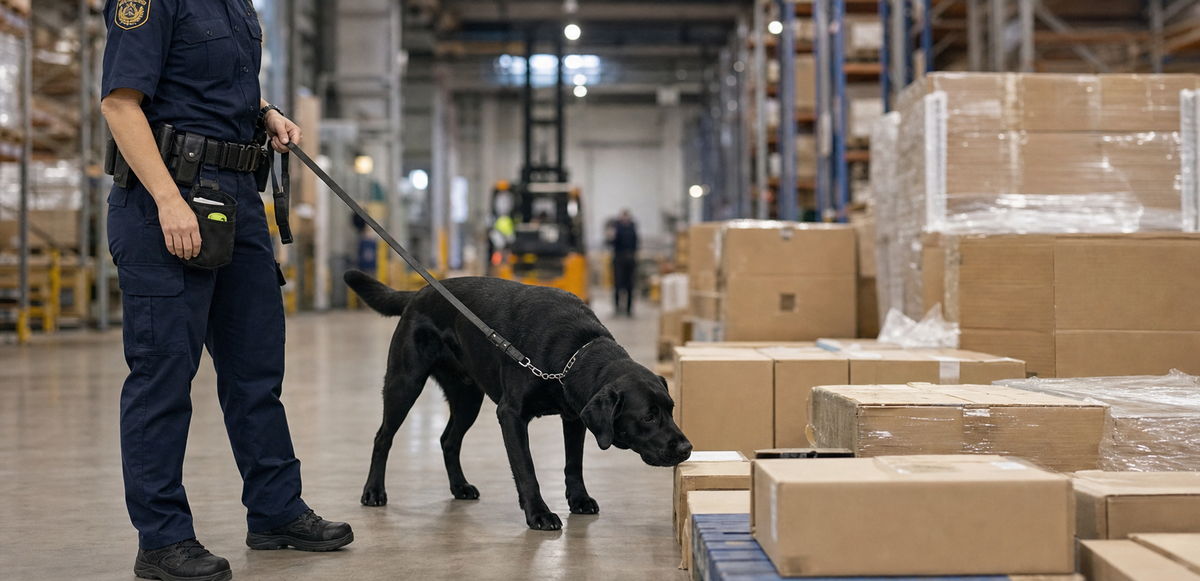
- Passive alert detection dogs indicate the presence of a target odour by sitting or freezing — not by scratching, barking or making contact with the source. This distinction shapes every aspect of their training, handling and equipment selection.
- Australian corrections services and state police K9 units deploy PAD dogs across prisons, courts, transport hubs and community settings for drug, currency and contraband detection.
- The reward system is the foundation of a PAD dog's operational reliability. Equipment that supports fast, consistent, low-profile reinforcement directly affects detection accuracy over time.
- A PAD dog's collar and lead must be functional across both high-throughput facility sweeps and close-quarters handler transitions — not just general-purpose dog control.
- Every PAD dog team should carry a purpose-built K9 first aid capability. Corrections and policing environments present specific injury risks, including needlestick hazards, assault, and confined-space incidents.
- Gear that is quiet, low-profile, and operationally intuitive reduces handler cognitive load in demanding environments.
- The right equipment does not replace training. It supports the consistent application of it.
Quick Reference: PAD Dog Roles and Gear Requirements
| Role | Environment | Gear Priority | Recommended Products |
|---|---|---|---|
| Drug detection | Prison facility, courts | Quiet collar, low-profile reward system | Origin K9 Patrol Collar, Operator Reward Pouch |
| Currency/contraband detection | Mail centres, transport | Durable lead, compact IFAK | Origin K9 1.8m Lead, Compact K9 IFAK |
| Community policing/events | Public venues, transit | Handler-accessible first aid | Compact K9 IFAK |
| Court and legal precinct | Secure facilities | Low-profile, no excess hardware | Origin K9 Patrol Collar |
What Is a Passive Alert Detection Dog?
Detection dogs broadly fall into two categories based on how they communicate a find to their handler: active alerters and passive alerters.
An active alert dog responds to a target odour by making physical contact with the source — pawing, scratching, or biting. This approach is common in explosive detection contexts where the handler needs an unambiguous, high-visibility indication.
A passive alert dog indicates by stopping and assuming a specific trained position — typically a sit, a down, or a freeze — without making contact. The response is deliberate and controlled. It does not disturb the source or draw unnecessary attention from bystanders.
In corrections and policing contexts, the passive alert is generally the preferred response. A dog that sits calmly beside a piece of luggage or a cell door communicates a find to the handler without alerting a subject, contaminating evidence, or creating a situation in a crowded environment.
That subtlety is operationally significant. It is also difficult to maintain across thousands of searches and years of deployment without consistent training, handler skill, and equipment that supports reliable reinforcement.
Where PAD Dogs Operate in Australia
Corrections Services
Every Australian state and territory corrections service deploys detection dogs. The specific scale and operational model varies by jurisdiction, but the core function is consistent: systematic detection of drugs, mobile phones, and other contraband in facilities where those items represent direct safety risks to staff, other detainees, and the broader community.
Dogs work cell searches, common areas, visitor processing, mail rooms, and vehicle inspections. Shifts are typically structured across a working day, with multiple dogs and handlers rotating through detection tasks. The environment is controlled, high-frequency, and operationally demanding — a dog may conduct dozens of individual searches in a single shift.
State and Federal Police
State police K9 units deploy PAD dogs across a broader range of environments: transit hubs, public events, schools, court precincts, and community operations. The Australian Federal Police maintains its own detection capability, including dogs deployed to international airports and seaports in coordination with the Australian Border Force.
The AFP's Airport Watch Program and ABF's border operations represent the highest-throughput detection environments in the country. A dog working Sydney International Airport may pass through thousands of passengers per shift across multiple terminals and baggage carousels.
Policing and Corrections: Different Environments, Same Principles
The settings differ significantly. A corrections dog working a maximum-security remand centre operates in a fundamentally different environment from a police dog working Sydney Airport's international terminal.
What does not differ is the underlying requirement: a dog that alerts reliably, a handler who can reinforce that alert consistently, and equipment that supports both without introducing variables that degrade performance over time.
How the Reward System Affects Detection Reliability
The passive alert is a conditioned behaviour. It is built through thousands of repetitions of a single pattern: dog detects target odour, dog sits or freezes, handler delivers reinforcement.
The speed, consistency, and quality of that reinforcement directly determines how reliable the behaviour is under operational conditions. A delay of even a few seconds between the alert and the reward introduces ambiguity. The dog does not know with certainty what it is being rewarded for.
This is where handler equipment becomes operationally relevant.
A reward pouch that is difficult to access under operational clothing, requires two hands to open, or makes audible noise during a facility sweep introduces exactly the kind of inconsistency that erodes detection performance over time. Handlers who train with equipment that does not match what they carry operationally face the same problem.
The Origin K9 Operator Reward Pouch is designed by former Australian Special Forces specifically to address this. It attaches via belt clip or MOLLE to a vest, opens via button snaps for single-handed access, and carries a 3-cup capacity with a waterproof lining that contains food reward without contaminating the pouch. A zip pocket holds secondary reward items — clickers, tracking articles, or poo bags — without mixing with primary food reward.
For handlers who need to move quickly between alert and reinforcement without breaking the dog's focus, the mechanics of the pouch matter. The Operator Reward Pouch is built for that transition.
Collar and Lead Selection for PAD Dog Work
The Patrol Collar in a Corrections Context
PAD dogs working in corrections facilities and court precincts operate in environments where excess hardware is a liability. Metal fittings that clank against surfaces, bulky collars that catch on doorframes, or leads that require two-handed management all introduce friction in environments that demand quiet, efficient handler-dog movement.
The Origin K9 Patrol Collar is hand-crafted from military-spec components and rated to a GT Cobra Buckle load of 2.2kN. It features a central V-ring for ambidextrous lead attachment, a gripped handle for close-quarters control, and Velcro for unit patch attachment where required. The padding mesh provides comfort across extended shifts without the bulk of a traditional working dog collar.
For PAD dog work, the gripped handle on the collar is particularly relevant. In a detection scenario where a dog has alerted and the handler needs to control the dog's position relative to the find without pulling on the lead — in a crowded corridor, beside a vehicle, or at a cell door — the collar handle provides a secondary control point that does not require reacquiring the lead.
Lead Length and Operational Context
The standard 1.8m lead is appropriate for the majority of PAD dog work in corrections and policing. It keeps the dog close enough for handler observation and rapid reward delivery, while providing sufficient range for the dog to work independently through a search area.
For handlers transitioning dogs between vehicles, buildings, or secure processing areas, the slip collar paired with the 1.8m lead offers the fastest on/off capability. Origin K9's slip collar uses a quiet material lead point rather than metal hardware — relevant in environments where noise discipline matters during a cell block sweep or a court precinct search.
K9 First Aid in Corrections and Policing Environments
Detection dogs in corrections and policing environments face injury risks that are distinct from those in field or hunting contexts. The threats are not primarily environmental — they are human.
Needlestick injuries are a documented occupational hazard for corrections dogs working areas where contraband drug paraphernalia may be present. Lacerations from concealed items, assault-related injuries, and the physical demands of extended shift work all represent real injury vectors that a handler may need to respond to in a facility environment — away from immediate veterinary access.
The Compact K9 IFAK is housed in an Operator 2.0 IFAK Pouch designed for handler-carry and rapid one-handed access. Contents include a SWAT-T Tourniquet, TraumaFix bandage, trauma shears, nitrile gloves, eyewash, antiseptic supplies, a thermometer, canine muzzle, and K9 Casualty Card.
The muzzle is not a welfare consideration — it is a safety one. A dog in pain bites. In a corrections facility or court precinct, a handler who cannot safely manage an injured dog creates a secondary incident in an already controlled-access environment. Having a muzzle within reach in the IFAK means the handler can secure the dog safely before administering any first aid intervention.
The K9 Casualty Card allows documentation of vitals, interventions, and timeline — directly transferable to the veterinarian who takes over care.
Common Operational Challenges for PAD Dog Teams
Reward Delivery Under Observation
In public-facing environments — airports, transport hubs, event venues — handlers are observed by the public, and conspicuous reward delivery can inadvertently signal the location of a find to a subject who is watching. Compact, quiet reward systems that allow rapid delivery without theatre are operationally preferred.
Maintaining Drive Across High-Frequency Search Days
A dog that conducts dozens of searches per shift is at risk of drive reduction if reinforcement quality or rate falls. Handlers who manage this well typically vary reward types, maintain high-value food reward for genuine alerts, and use non-food reward (play, praise) strategically for training contexts. A pouch that keeps food reward fresh, separate, and instantly accessible supports this management.
Equipment Wear in Institutional Environments
Corrections facilities and court precincts are hard environments for equipment. Metal hardware corrodes in cleaning chemical atmospheres. Stitching degrades with repeated washing. Buckles that depend on precise fit become unreliable when swollen or worn. Military-spec components — as used across the Origin K9 range — are selected for durability in exactly these conditions.
Transition Between Detection and General Patrol
Some K9 teams transition the same dog between detection and general patrol duties within a single shift. Equipment that functions across both roles — a collar with a handle for patrol control and a V-ring for detection lead attachment, a lead that meets both obedience and detection working distances — reduces the number of gear changes required and the potential for equipment mismatches.
How Southern K9 Systems Supports Corrections and Police K9 Teams
Southern K9 Systems distributes specialist K9 equipment to law enforcement, corrections, defence and security organisations across Australia and internationally. The product range is selected based on operational feedback from active handlers and informed by the K9 TECC framework.
For corrections and police PAD dog teams, Southern K9 Systems stocks:
- Origin K9 Patrol Collar — purpose-built for operational working dogs, available in Black and Multicam Black in Medium and Large sizes
- Operator Reward Pouch — designed for professional K9 handlers, with MOLLE backing, waterproof lining, and single-handed access
- Compact K9 IFAK — a handler-carry first aid kit built for working dog emergencies in high-risk environments, available in Black and Tan
All products ship domestically across Australia. Free shipping is available on orders over $300. For unit procurement or bulk orders, contact Southern K9 Systems directly.
Final Thoughts
The passive alert is one of the most refined behaviours in working dog training. It demands precision from the dog, consistency from the handler, and an operational environment that does not work against either.
Equipment does not make a PAD dog. Consistent, high-quality training over years of work does that. But equipment that is poorly suited to the role introduces variables that compound over time — slower reinforcement, collar hardware that shifts during a search, a first aid kit that is inaccessible when it is needed.
The details matter. For Australian corrections and police K9 teams operating at high frequency in demanding environments, selecting gear to the same standard as the training program is not an indulgence. It is an operational baseline.
FAQs
What is the difference between a passive and active alert detection dog?
A passive alert dog indicates a find by stopping and assuming a trained position — typically a sit or freeze — without making physical contact with the source. An active alert dog responds by making contact, such as scratching or pawing. Passive alerts are generally preferred in corrections and policing contexts because they are lower-profile, reduce the risk of evidence contamination, and are safer in crowded environments.
What contraband do corrections detection dogs target in Australia?
Australian corrections detection dogs are primarily trained for illicit drugs — including methamphetamine, cannabis, heroin, and MDMA — as well as mobile phones, tobacco (in smoke-free facilities), and currency. Some jurisdictions train dogs for specific emerging threats based on facility intelligence.
How often do PAD dogs work in a typical corrections shift?
This varies significantly by jurisdiction and facility type. In high-throughput remand centres, a detection dog team may conduct dozens of individual searches across a shift. In lower-traffic environments, the number is smaller but the expectations of reliability remain the same.
Why does the reward pouch matter for detection accuracy?
The speed and consistency of reinforcement delivery directly affects how reliably a dog maintains its trained alert behaviour. A pouch that is difficult to access or introduces a delay between alert and reward creates ambiguity in the learning history. Over time, this can reduce alert reliability, particularly in low-odour scenarios where the dog's confidence in its own indication is the deciding factor.
Can the Origin K9 Patrol Collar be used in a corrections facility?
Yes. The Origin K9 Patrol Collar is designed for operational working dog environments. Its low-profile padding, load-rated GT Cobra Buckle, and Velcro patch area make it appropriate for corrections use. The gripped handle provides a secondary control point without requiring the handler to reacquire the lead — relevant in confined corridor and cell block environments.
What injuries are most common for corrections detection dogs?
Needlestick injuries from concealed drug paraphernalia are a documented risk in corrections detection work. Lacerations from sharp concealed items, overheating in poorly ventilated spaces, and physical wear from extended high-frequency shift work are also relevant. A handler-carry compact IFAK addresses the immediate response for most of these scenarios.
Are Southern K9 Systems products available for government procurement?
Southern K9 Systems supplies law enforcement and corrections organisations across Australia. For unit procurement, bulk pricing, or government invoicing requirements, contact Southern K9 Systems directly via southernk9systems.au.
Shop the Range
Gear built for Australian corrections and police K9 teams — patrol collars, reward pouches, compact IFAKs and leads engineered to operational standards. Free domestic shipping on orders over $300.
Shop Southern K9 Systems
Share:
What Gear Do Biosecurity Detection Dog Handlers Need in Australia?
Search and Rescue K9 in Australia: Operational Standards, Handler Responsibilities and Equipment Selection