


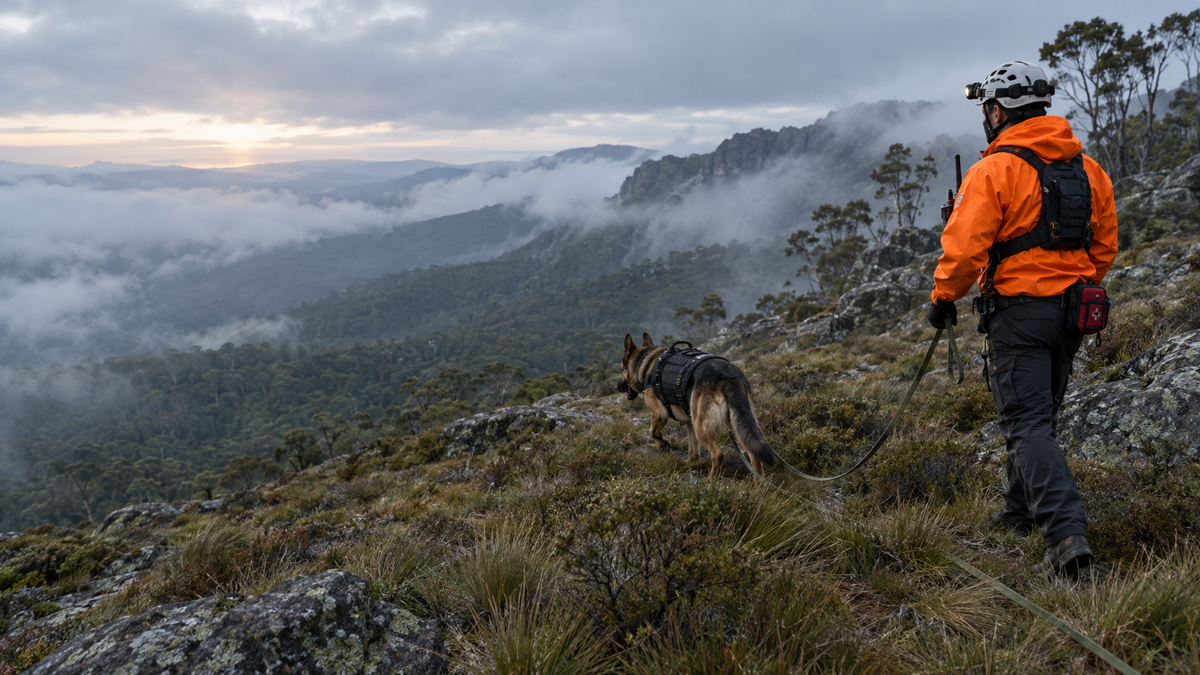
Search and Rescue K9 in Australia: Operational Standards, Handler Responsibilities and Equipment Selection
- Search and rescue K9 in Australia operates across some of the most demanding terrain environments in the world — from dense Tasmanian rainforest to arid outback and coastal bushland.
- Australian SAR K9 teams are primarily volunteer-based, operating under state and territory emergency management frameworks with varying levels of resourcing.
- A SAR dog's effectiveness is directly linked to the handler's ability to maintain the dog's welfare, navigate terrain, communicate with incident command, and respond to a canine medical emergency in the field.
- Harness selection for SAR K9 is not a cosmetic decision — it determines what the dog can do, how it can be extracted if injured, and whether it can operate safely in technical terrain.
- Every SAR K9 team should carry a field medical capability appropriate to the operating environment. In remote Australian terrain, that means a kit capable of managing life-threatening injuries without immediate veterinary access.
- Long-line lead discipline is a foundational skill in SAR K9 work, and the lead itself must meet the load ratings and durability standards that remote, rough terrain demands.
- Pre-deployment equipment checks and documented SOPs reduce the variables that cause SAR K9 deployments to fail.
Quick Reference: SAR K9 Equipment by Role
| Task | Environment | Key Capability Requirement | Recommended Equipment |
|---|---|---|---|
| Area search (air scent) | Open bush, urban fringe | Long-line control, handler mobility | Origin K9 9.1m Lead |
| Trailing / tracking | Dense scrub, mixed terrain | Close-range control, harness durability | EARTSCH K9 Assault Vest |
| Technical terrain (cliff, water) | Mountain, gorge, coastal | Hoisting compatibility, extraction capability | EARTSCH K9 Assault Vest with Lift Kit |
| Canine trauma response | Any field environment | Haemorrhage control, wound management | Large K9 IFAK |
| Dog extraction / litter carry | Remote terrain, injury | Safe transport of non-ambulatory dog | EARTSCH K9 Litter |
The Role of K9 in Australian SAR Operations
Search and rescue K9 teams operate across all Australian states and territories, primarily under the coordination of state police or emergency services — SES, QFES, DFES, TFS, and their equivalents. The AFP maintains its own specialist K9 capability for federal jurisdictions. Volunteer SAR K9 teams operate under varying governance frameworks, many affiliated with organisations such as Search and Rescue Dogs Australia (SARDA) or state-level volunteer emergency management bodies.
The core capability a SAR dog provides is scent detection — either of a specific individual (trailing or tracking) or of human scent generally (air scent search). In a bushland missing person scenario, a trained SAR dog can cover terrain and detect human presence at distances and in conditions that exceed what any human-only search team can achieve.
That capability depends entirely on the dog's training, the handler's skill, and the team's operational readiness — including equipment.
Australian SAR Terrain: Why It Matters for Equipment Selection
SAR K9 teams in Australia operate in environments that are not well-represented in overseas training doctrine. The terrain is varied, unforgiving, and often remote in ways that create specific equipment requirements.
Tasmanian and Victorian Alpine Terrain
Buttongrass moorland, dense rainforest, rocky ridgelines, and rapidly changing weather make this some of the most technically demanding SAR terrain in Australia. Dogs operating in the Tasmanian highlands face mud, cold, and dense undergrowth that puts significant demands on harness durability and handler mobility.
Queensland and Northern Territory Scrub
Heat is the primary risk factor. Extended ground searches in north Queensland or the Northern Territory in summer create significant thermoregulatory demands for both dog and handler. Equipment that adds unnecessary weight or restricts airflow around the dog's body compounds this risk.
Coastal and Urban Fringe Environments
Cliff-top searches, coastal dune systems, and the dense peri-urban bushland that surrounds most Australian capital cities present different challenges: steep terrain where a dog could fall, salt-loaded air that accelerates hardware corrosion, and the need to transition quickly between dense scrub and open ground.
Each of these environments informs harness selection, lead length, first aid capability, and extraction planning.
Harness Selection for SAR K9
The harness is the most consequential piece of equipment a SAR dog wears. It determines how the handler controls the dog in dense scrub, whether the dog can be safely hoisted in technical terrain, and how quickly the dog can be extracted if it is injured and cannot walk out.
The EARTSCH K9 Assault Vest
The EARTSCH K9 Assault Vest is a German-made tactical canine vest built to the standard expected in military working dog and technical SAR deployments. It uses 44mm MilSpec Type VIII Webbing (MIL-W-4088) and AustriAlpin COBRA® ProStyle Buckles throughout — the same hardware standard used in parachuting and load-bearing military equipment.
The mesh body provides airflow in hot conditions while the reinforced construction maintains structural integrity in rough terrain. The laser-cut MOLLE back panel allows attachment of additional pouches — medical kit, tracking articles, or other mission-specific equipment.
For SAR teams operating in technical terrain, the EARTSCH K9 Assault Vest with Lift Kit adds hoisting capability via a hoist/rappelling adapter with two carabiners, leg harness attachment, and backpack straps. This is the appropriate configuration for teams operating near cliff edges, water features, or any terrain where a dog could require vertical extraction.
All EARTSCH products are handmade to order. Lead times vary, and Southern K9 Systems recommends contacting prior to ordering to confirm current availability.
Harness Fit and Working Clearance
A harness that does not fit correctly is a liability in field conditions. A loose harness shifts during movement, creating chafe points and reducing the handler's ability to control the dog through the handle or attachment point. A harness that is too tight restricts movement and can cause pressure sores across extended operations.
EARTSCH harnesses are sized to measurement. Teams deploying EARTSCH equipment for the first time should allow adequate lead time for the measurement, production, and delivery process.
Lead Selection and Long-Line Discipline
Long-line work is foundational to area search SAR K9. The dog works at distance from the handler, covering ground independently, while the handler maintains connection via a lead long enough to allow that working distance without losing control of the team.
The Origin K9 9.1m / 30ft Lead is the appropriate length for area search work. It provides sufficient range for the dog to work ahead while keeping the handler in the loop. Load rated to the same standard as the full Origin K9 lead range — 480kg — with an in-built swivel to prevent twist accumulation across a long search day.
In dense scrub, long-line management is a physical skill. The lead must be managed actively to prevent snagging, and the handler must be able to recover distance quickly when the dog indicates. A lead that twists, binds, or fails at the hardware under load introduces exactly the kind of variable that causes a SAR K9 indication to be missed or misread.
Field Medical Capability for SAR K9
SAR operations in remote Australian terrain can place handler-dog teams hours from road access and significantly longer from veterinary care. A dog that sustains a significant injury during a search — a deep laceration from barbed wire or sharp rock, a snake bite, a fall-related injury — requires immediate field care that cannot wait for evacuation.
The Large K9 IFAK is the appropriate medical baseline for SAR K9 teams operating in remote or semi-remote environments. It provides haemorrhage control, wound management, bandaging, tourniquet capability, and the supplies needed to stabilise a dog for evacuation without immediate veterinary access.
For teams operating in areas with significant snake risk — which encompasses most of eastern and northern Australia — the snake bite bandage included in the IFAK and the aluminium splint for limb immobilisation are directly relevant. A dog bitten during a search needs pressure immobilisation applied quickly and needs to be moved to veterinary care as a priority. Immobilising the affected limb reduces lymphatic spread of venom.
The canine muzzle in the IFAK is not optional. A dog in pain bites. In the field, a handler managing an injured dog alone — which is frequently the situation in SAR deployments — cannot safely apply a wound dressing without first muzzling the dog.
When the Dog Cannot Walk Out
The EARTSCH K9 Litter is a lightweight field litter designed for canine extraction — moving an injured dog across terrain where it cannot self-ambulate. At $179.90, it is a critical capability for SAR teams operating in terrain where a dog with a bilateral limb injury, suspected spinal injury, or severe heat incapacitation cannot be safely carried by hand over any meaningful distance.
For teams operating in truly technical terrain requiring vertical extraction or water rescue, the EARTSCH K9 Rescue Lifting Litter at $419.90 provides the structural integrity and attachment points required for those scenarios.
Common Operational Challenges for SAR K9 Teams
Equipment Not Matched to Terrain
A harness appropriate for urban environments may not provide adequate durability or hoisting compatibility in technical terrain. SAR teams that operate across diverse environments benefit from reviewing their equipment against each specific terrain type they are likely to be deployed to — not just their most common deployment scenario.
Long-Line Management in Dense Scrub
Long-line handling in thick bush is a skill that requires specific training. Teams that train primarily in open parkland or paddock environments may underestimate the difficulty of managing a 9.1m lead in dense Victorian or Tasmanian scrub. This is worth incorporating explicitly into operational training.
Welfare During Extended Operations
SAR operations can run for days. Dogs deployed across multiple operational periods require active welfare management — hydration, rest, drive maintenance, and post-deployment health checks. The welfare protocols that apply to a single shift apply with compounding urgency to multi-day operations.
First Aid Training
A first aid kit is only as useful as the handler's ability to use it. SAR K9 teams should ensure that at least one member per team has completed K9 first aid training and is familiar with all items in the team's IFAK. The K9 First Aid Handbook and K9 TECC Reference Cards provide field-readable guidance for handlers who need to act quickly under stress.
How Southern K9 Systems Supports SAR K9 Teams
Southern K9 Systems distributes specialist K9 equipment to volunteer and professional SAR teams across Australia. The SAR-relevant product range includes:
- EARTSCH K9 Assault Vest — field-grade canine vest for working SAR dogs, from $1,190.00
- EARTSCH K9 Assault Vest with Lift Kit — adds hoisting and rappelling capability, $1,790.00
- EARTSCH K9 Litter — lightweight canine field litter for extraction, $179.90
- Large K9 IFAK — field medical capability for remote SAR environments, from $299.96
- Origin K9 9.1m Lead — long-line for area search work, $79.90
Free domestic shipping is available on orders over $300. EARTSCH products are handmade to order — contact Southern K9 Systems prior to ordering to confirm lead times and sizing requirements.
Final Thoughts
SAR K9 is one of the most demanding applications of working dog capability in Australia. The terrain is difficult, the deployments are often long, the stakes are high, and the operational environment frequently removes the safety nets that other K9 roles take for granted.
Equipment that works in training must also work in the field. A harness that holds up in a paddock needs to hold up on a rocky ridgeline after six hours of scrub work. A first aid kit that is stocked in a training bag needs to be accessible and complete when it is genuinely needed.
Getting these decisions right before the deployment is the work. Southern K9 Systems provides the equipment. The preparation is the team's responsibility.
FAQs
What certifications or frameworks govern SAR K9 teams in Australia?
SAR K9 governance varies by state and territory. Most volunteer teams operate under state emergency management frameworks — SES, QFES, DFES, and equivalents — and are subject to those organisations' training and accreditation requirements. Search and Rescue Dogs Australia (SARDA) provides a national framework for evaluation and accreditation. Teams affiliated with state police SAR units operate under police governance. There is no single national standard, though K9 TECC is increasingly referenced as the framework for canine medical response.
Can the EARTSCH K9 Assault Vest be used for everyday patrol as well as SAR?
Yes. The EARTSCH vest is designed as an all-roles working dog vest. Its durability, MOLLE compatibility, and load-rated hardware make it appropriate for patrol, detection, SAR, and tactical roles. The primary consideration is fit — it must be correctly sized for the individual dog.
What is the difference between the EARTSCH Litter and the Rescue Lifting Litter?
The standard EARTSCH K9 Litter ($179.90) is a lightweight field litter for manual carry across terrain. The Rescue Lifting Litter ($419.90) adds structural reinforcement and attachment points for vertical extraction — winching, hoisting, or lowering in technical terrain. Teams operating near cliff lines, in gorges, or in water rescue environments should carry the Rescue Lifting Litter.
How long a lead should a SAR K9 team carry?
For area search work, the standard is a long-line in the 9–10m range. The Origin K9 9.1m lead is the appropriate choice. Some handlers also carry a shorter 1.8m lead for transitions, vehicle loading, and close-quarters control. Both leads should meet the same load-rating and hardware standard.
Are SAR K9 first aid kits different from standard working dog IFAKs?
The core contents are largely the same — haemorrhage control, wound management, airway, thermal, muzzle, casualty documentation. The SAR context adds specific relevance to snake bite management (pressure immobilisation bandage, splint), remote evacuation planning (thermal blanket, litter compatibility), and extended operation welfare (thermometer for heat monitoring). The Large K9 IFAK covers these requirements.
What are the most common injuries sustained by SAR dogs in Australian field conditions?
Laceration from barbed wire, sharp rock, and dense undergrowth is the most common serious injury. Snake bite is a significant risk across most of eastern and northern Australia. Pad injuries — cuts, abrasions, and foreign body penetration — are frequent and should be inspected post-operationally. Heat-related illness is the primary risk in warm-weather deployments.
Can Southern K9 Systems assist with unit or team procurement for a volunteer SAR organisation?
Yes. Southern K9 Systems supplies equipment to volunteer and professional SAR organisations across Australia. For team procurement, bulk pricing, or invoicing requirements, contact Southern K9 Systems directly via southernk9systems.au.
How often should SAR K9 harnesses and leads be inspected for wear?
Before and after every deployment, at minimum. Webbing, stitching, and hardware should be checked for abrasion, UV degradation, and corrosion, particularly after saltwater or heavy mud exposure. Teams operating frequently in technical terrain should schedule a more thorough inspection on a fixed monthly cycle, with any compromised component replaced before the next deployment rather than after a failure in the field.
Specialist Working Dog Equipment
Origin K9, EARTSCH and K9 first aid capability — available now with free domestic shipping on orders over $300.
Shop Southern K9 Systems
Share:
Passive Alert Detection Dogs in Australian Corrections and Policing: How Gear Choice Affects Operational Outcomes